Targeting the Two Holy Mosques and Its Impact on the Islamic Ummah
In the name of Allah, the Most Gracious, the Most Merciful.
Praise be to Allah, and peace and blessings be upon the Messenger of Allah, his family, and all his companions. To proceed:
In this article, we will outline a summary of the heinous crime committed by the Houthi militia—a blatant attack against the most sacred religious sites, a violation of the sanctity of human life, and an aggression against state sovereignty. All of these acts violate Islamic Sharia, prior divine revelations, and international laws that deem such attacks a breach of international legal principles safeguarding human life, religious sanctities, and state sovereignty. Furthermore, this article explores the reality of the Houthi terrorist group, its danger to the Ummah, the rulings of various scholars regarding this militia, the repercussions of targeting the Two Holy Mosques, and a summary of international and regional condemnations.
At the outset, we condemn in the strongest terms these cowardly terrorist acts targeting the Qibla of Muslims, the focus of their hearts, and the city of the Messenger of Allah (peace and blessings be upon him). Directing weapons toward Makkah—home to the Sacred House of Allah—and toward Madinah—home to the tomb of the Chosen Prophet—is mischief on Earth and conclusive proof that this militia is devoid of any religious, moral, or human conscience.
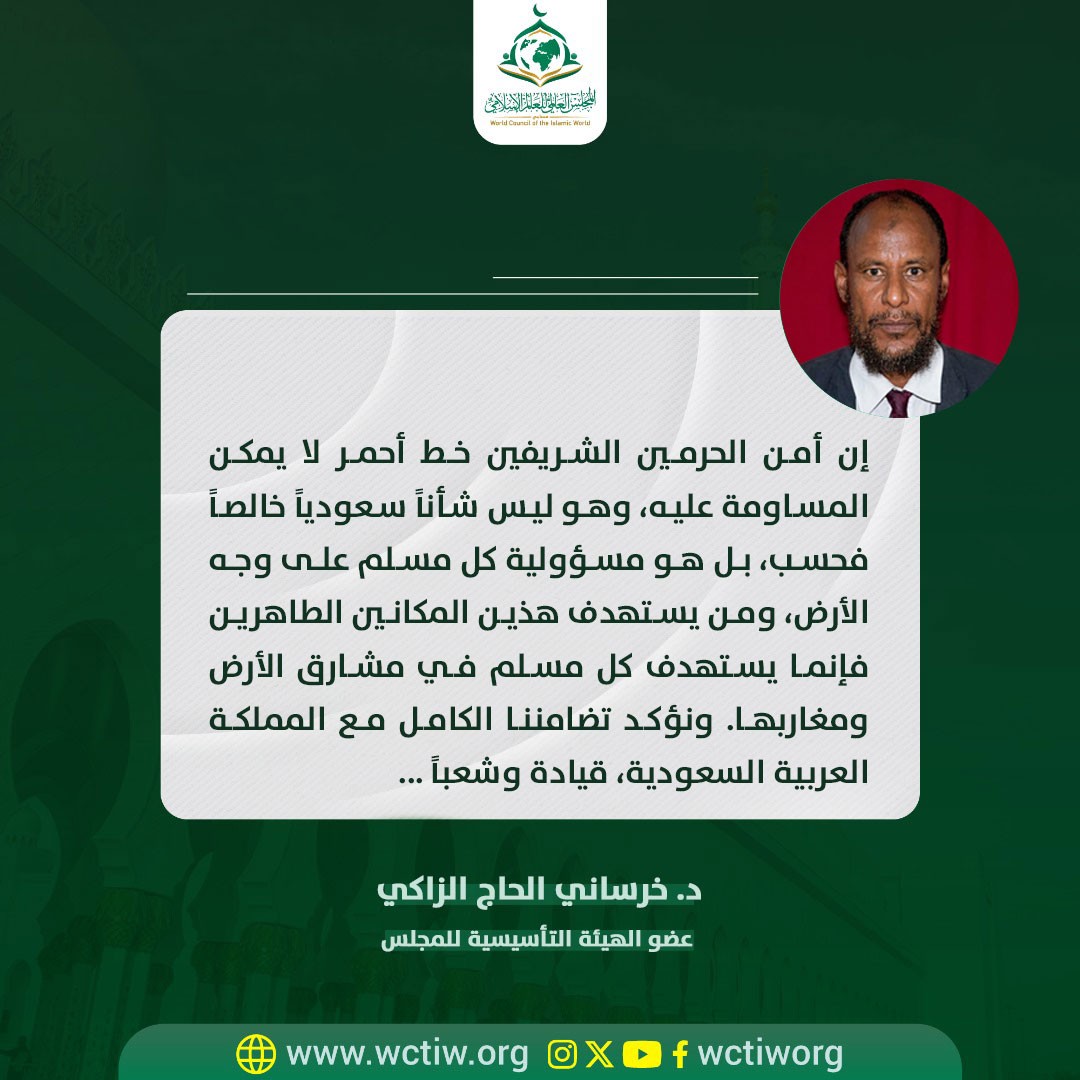
The security of the Two Holy Mosques is an uncompromisable red line; it is not solely a Saudi affair, but the responsibility of every Muslim on Earth. Anyone targeting these two sacred places targets every Muslim across the globe. We affirm our full solidarity with the leadership and people of the Kingdom of Saudi Arabia in all measures taken to protect its territory, holy sites, citizens, and residents, as well as its inherent right to self-defense under Article 51 of the UN Charter.
First: Targeting the Two Holy Mosques is a Crime Beyond Politics, Striking at the Core of the Ummah’s Faith
The systematic targeting of the vicinity of the Two Holy Mosques by the Houthi terrorist militia—ranging from attempting to launch an explosive-laden drone into the restricted airspace over Makkah Mukarramah to targeting the Taiba Power Plant that supplies the Prophet’s Mosque in Madinah Munawwarah—is not merely a passing military action. Rather, it is a flagrant assault on the sanctities of the entire Islamic Ummah and a violation of all religious, moral, and legal red lines.
Second: The Houthi Terrorist Group and Its Danger to the Ummah
The Houthis are a transgressing faction that allied with groups that sold their religion and homeland to secure personal and worldly gains at the expense of Yemen’s Arab identity and faith. They are driven by enemies united in hostility toward Arabs and Muslims, aiming to divide their states and plunge them into strife and conflict. They seek to plant this group as a thorn in the side of the Arabian Peninsula, attempting to replicate the scenarios seen in the Levant and Iraq. Neither Arabs nor Muslims have reaped any good from this group; instead, they have wreaked havoc, injustice, and aggression in those lands. Undeniably, this faction has become an enemy of peace, a destabilizer of security, and a direct threat to the security and stability of the Land of the Two Holy Mosques and the Gulf States.
The Houthis are an alien element in Yemen—a clique that committed the most atrocious crimes, including displacing people, violating honors, shedding blood, blocking roads, and halting daily life by destroying mosques, schools, and institutions. Furthermore, these outlaws had the audacity to attempt attacks on the Kingdom’s borders, threatening to invade the Two Holy Mosques and strike them with missiles, terrorist operations, and acts of sabotage.
Through their desperate and failed attempts, the Houthis aim to destabilize the security of the Land of Monotheism and Sunnah, the host of the Two Holy Mosques, thereby serving the enemies of Islam. By Allah’s power, protection, and victory, followed by the vigilance and resolve of our brave security personnel and heroic soldiers, they will never achieve their aims.
The desperate attempts by the Houthi insurgent group to compromise the security, holy sites, borders, and southern regions of the Land of the Two Holy Mosques demonstrate the depth of their despair and frustration. It is a death throe following repeated defeats and dismal failures in achieving their malevolent goals. Their missile attacks and misleading propaganda are nothing more than reckless displays of absurdity that will yield no benefit, fulfill no hope, nor raise their status:
“But the evil plot encompasses only its authors.” [Quran 35:43]
We seek refuge in Allah from tyranny and its perpetrators, from its bad turns, and from its shameful outcome. We ask Allah to suppress their hostility and aggression, for Allah is stronger in might and stronger in punishment. (1)
Third: Scholars’ Statements on the Aggression Against Islamic Sacred Sites
From the perspective of Islamic Sharia, mosques enjoy a sacred status guaranteed by explicit texts that mandate their protection and forbid targeting them or turning them into arenas of conflict, whether in times of peace or war.
The recent attack that damaged a mosque in the Jazan region serves as additional evidence of the militia’s violation of Islamic principles and values. This exposes its use of religion as a mere cover for political deception and to mask its violations against civilian objects and places of worship.
Dr. Qais Al-Mubarak, former member of the Council of Senior Scholars in Saudi Arabia, stated:
“Preserving human life is one of the essential necessities of creation. A Muslim is commanded to safeguard it and take all measures to protect it, a principle agreed upon by consensus among Muslims. This principle becomes even more emphasized when killings occur in places of worship.”
Dr. Al-Mubarak stressed that the harm inflicted by the Houthis on the people of Yemen, including destroying homes over their occupants, is among the greatest abominations. He added:
“Today, they target the sacred places in the Two Holy Mosques without regard for the pilgrims and visitors, indifferent to the harm their indiscriminate attacks cause to adults, children, and the elderly. This is a grave evil rejected by any nation, forbidden by all divine laws, and committed only by those who hold no value or respect for human life. The preservation of life is universally agreed upon among Muslims.”
For his part, Dr. Yousuf Al-Rumaih, Security Consultant and Professor of Criminology and Counter-Terrorism at Qassim University, noted that the Houthi terrorist attacks on holy sites inside Saudi Arabia demonstrate a disregard for basic Islamic principles despite their outward claims of adhering to Sharia. In reality, these claims remain mere slogans while their reckless projectiles target the holiest sanctuaries of Muslims. Dr. Al-Rumaih emphasized that this terrorist group is subservient to regional agendas and targets the core of Saudi Arabia, which houses the Qibla of Muslims. He highlighted the negative impact of such subservience on many Arab countries, leaving them vulnerable to divisions and destroying their social stability and peace.
Dr. Al-Rumaih called upon the intellects and institutions of the Islamic Ummah to confront the behavior of the Houthi terrorist group whose evils have reached Islamic sanctities, pointing out the necessity of initiating the confrontation on an intellectual level to strip the group of its false claims and expose its reality in attacking societal security and national stability.
Dr. Muhammad Al-Omari, researcher in the history of Islamic legal sciences, stated that the recent Houthi attacks have transcended military and security dimensions to constitute a direct assault on the sanctity of Islamic holy sites and a provocation to the feelings of over two billion Muslims worldwide. (2)
Commenting on the brutal attack on the Two Holy Mosques, writer Khalid bin Hamad Al-Malik wrote:
“Even Makkah Mukarramah, with its sacred status for 1.5 billion Muslims, was not spared from the attacks of the Houthi terrorist militia—those who claim to be ‘Ansar Allah’ (Supporters of God). How can they be so when they attack the Qibla of Muslims and target those prostrating in worship at the Sacred House of Allah, completely devoid of religion, conscience, or morals?”
He added that the Houthi targeting of holy places is a dangerous development requiring a firmer international stance, particularly toward Iran—the source of funding and supplier of long-range drones and ballistic missiles to this terrorist organization. This support has placed the lives of millions of Muslims under terrorist threat, requiring all Islamic nations to unite behind the Kingdom to protect Muslim holy sites, ensure their security, and prevent any future attacks. (3)
Fourth: Impact of the Targeting on the Islamic Ummah
This sinful targeting carries grave consequences that extend beyond limited physical damage:
-
Provocation of the Feelings of Two Billion Muslims: The Two Holy Mosques are not merely cities; they are the symbol of the Ummah’s unity and identity. Any harm directed at them wounds the feelings of every Muslim, sows discord, and fuels extremism.
-
Threat to the Pilgrimage (Hajj and Umrah): Targeting service infrastructure, such as the power plants supplying the Prophet’s Mosque, is a malicious attempt to disrupt services provided to the Guests of the Merciful and undermine the Kingdom’s immense efforts in serving pilgrims and visitors.
-
Exposing the Reality of the Houthi Project: These attacks reveal that this militia is an instrument implementing foreign agendas that wish no good for Yemen or the Islamic world. It consistently chooses escalation and dragging Yemen into further suffering over the path of peace, for which the Kingdom has exerted tireless efforts since the 2014 coup. (4)
Fifth: Islamic Unity Against Houthi Aggression
Conversely, this aggression served as a catalyst for unifying the voice of the Ummah. Condemnations poured in from Al-Azhar Al-Sharif, the Muslim World League, the Organization of Islamic Cooperation (OIC), the Arab League, and the International Council for the Islamic World (WCTIW)
The International Council for the Islamic World condemned in the strongest terms of denunciation this heinous criminal act committed by the Houthi terrorist militia in attacking the Two Holy Mosques. The Council praised the vigilance of the Royal Saudi Air Defense Forces and declared its full solidarity with Saudi Arabia in all measures taken to protect the Ummah’s holy sites. Islamic nations similarly condemned the targeting and expressed their solidarity with the Kingdom, reaffirming that the defense of the Two Holy Mosques is a matter of absolute consensus.
History will record that despite all these provocations, the Kingdom remained committed to the path of a comprehensive political solution in Yemen, while the militia chose the path of terrorism. (5)
Sixth: Aggression Against Sanctities Reveals Houthi Contradictions
Repeated attacks on places of worship highlight the stark contradiction between the declared rhetoric of the Houthi militia and its conduct on the ground. The Iran-backed group attempts to cloak itself in religion and adopt sectarian slogans to advance its military agenda, whereas its actions reflect its functional role in executing regional plans that destabilize the region and target its religious and civilian foundations.
The frequency of Houthi attacks has seen a systematic escalation targeting Islamic sanctities and civilian objects inside Saudi Arabia, including attempts directed toward Makkah and Madinah, alongside physical damage to a mosque and civilian injuries in the Jazan region—a blatant violation of International Humanitarian Law.
Saudi authorities noted that the deliberate, direct targeting of places of worship and residential areas represents a clear breach of international conventions prohibiting the involvement of religious and civilian facilities in military operations. Participants at the 4th ASEAN International Conference (“Khair Ummah”) condemned the Houthi militia’s firing of drones and missiles toward Makkah Mukarramah and Madinah Munawwarah, as well as its targeting of civilian objects in Saudi Arabia.
Seventh: Houthi Violations of International Law by Targeting Places of Worship
The Houthi targeting of civilian objects within Saudi Arabia—including a mosque in Al-Tuwal Governorate in the Jazan region—constitutes a flagrant violation of international law, adding to the militia’s recent regional escalation and highlighting its criminality, according to observers speaking to Asharq Al-Awsat.
Under the Rome Statute of the International Criminal Court (ICC), intentionally directing attacks against buildings dedicated to religion is prohibited, provided they are not military objectives, and constitutes a war crime in both international and non-international armed conflicts. Furthermore, places of worship possessing cultural or spiritual significance enjoy special protection under Article 53 of Additional Protocol I and Article 16 of Additional Protocol II to the Geneva Conventions. Rule 38 of Customary International Humanitarian Law likewise highlights the obligation to avoid damaging buildings dedicated to religion.
Consequently, deliberate attacks on mosques and places of worship during armed conflicts constitute a violation of International Humanitarian Law and may amount to a war crime when the facility is not a military objective.
Political analyst Ahmed Al-Ibrahim confirmed to Asharq Al-Awsat that these irresponsible practices by terrorist groups through targeting places of worship reflect the nature of the militia as a functional proxy serving regional agendas without respect for the sanctity of mosques or regard for Islamic teachings, in addition to targeting protected civilian objects under international law.
Political analyst Abdul Latif Al-Melhem stated that these attacks represent a continuation of the Houthi militia’s systematic hostile approach and its attacks on residential sites and vital infrastructure in defiance of international and humanitarian laws. It embodies their extremist behavior, rejection of peace efforts, and threat to regional and international security and stability.
Eighth: The International Community Assuming Its Responsibilities
Both Al-Ibrahim and Al-Melhem agree that the timing of these attacks—coinciding with the militia’s attempts to control the Bab al-Mandab Strait and impose a blockade on maritime navigation—provides the international community with a definitive picture of the expected behavior of this group if allowed to persist. It portends a grave threat to the region’s security and economic future if the international community delays in assuming its responsibilities to combat this group’s criminality. (6)
May Allah protect the Two Holy Mosques, preserve the Kingdom of Saudi Arabia as a fortress for Islam and Muslims, and turn the plots of the aggressors back against them.
Sources:
-
(1) Excerpt from the sermon: The Houthis and Their Danger – Sheikh Muhammad bin Ibrahim Al-Subr (Al-Alukah Network; Date added: June 18, 2019 / Shawwal 16, 1440 AH).
-
(2) Asharq Al-Awsat Newspaper.
-
(3) Al-Jazirah Newspaper: Thursday, September 17, 2026 – Khalid bin Hamad Al-Malik.
-
(4) ASEAN Conference (“Khair Ummah”).
-
(5) Al-Anba Kuwaiti Newspaper: Thursday, September 17, 2026.
-
(6) Asharq Al-Awsat Newspaper: Tuesday, October 6, 2026 / Rabi’ al-Thani 25, 1448 AH – Riyadh: Ghazi Al-Harthi.
Prof. Dr. Kharsani Al-Hajj Ibrahim Al-Zaki
Founding Member of the International Council for the Islamic World
Former Professor of Usul al-Fiqh (Principles of Jurisprudence) at Imam Mohammad Ibn Saud Islamic University and King Faisal University