Prince Mohammed bin Salman: When the state is redefined and stability is built in the Islamic world
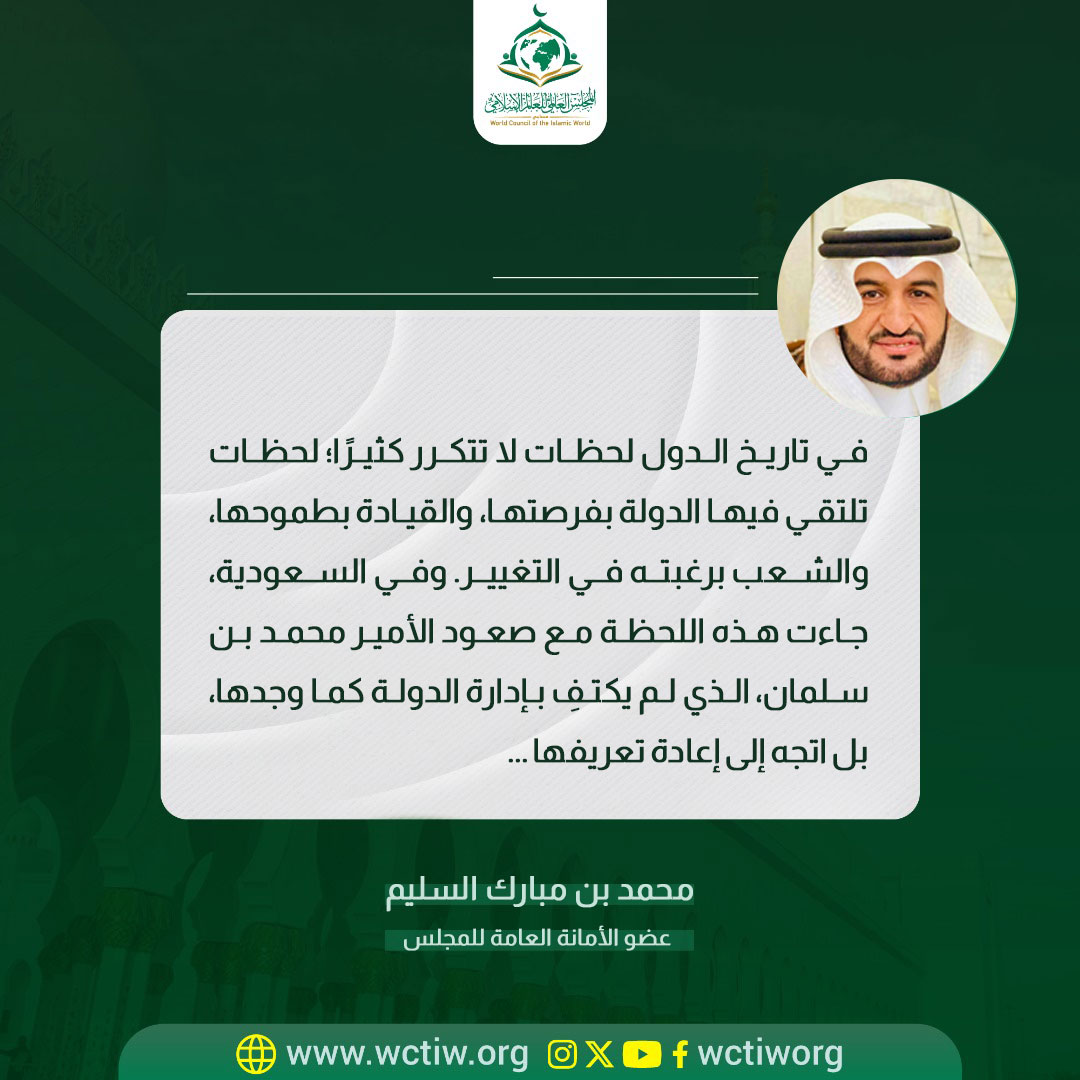
In the history of nations, there are moments that rarely occur; moments when a nation meets its opportunity, its leadership its ambition, and its people their desire for change. In Saudi Arabia, this moment arrived with the rise of Prince Mohammed bin Salman, who did not simply manage the state as he found it, but rather sought to redefine it: from a state that preserves its heritage and reinforces its identity, to a state that reshapes its future and modernizes its tools for the next century.
Internally, the Prince’s vision was a project to re-engineer the state, not merely to beautify it. The ambition was not for Saudi Arabia to “resilience,” but for Saudi Arabia to “advance,” and to advance not as a mere number in the global economy, but as a center of influence on its maps. Therefore, the vision was imbued with meanings previously unfamiliar in the region: diversification, transformation, investment, competitiveness, sustainability, and innovation. The vision was not a “government plan,” but a transformation of a nation.
On the Arab and Islamic levels, His Royal Highness the Crown Prince presented a different model for managing relations, one based on reducing tensions and repairing ties between nations, rather than a policy of alliances. Building bridges proved more beneficial than erecting walls in a region burdened by conflicts, and prioritizing shared interests was more conducive to preserving stability.
This approach extended to the Islamic world through supporting the internal stability of Muslim states and adopting a moderate discourse grounded in the values of the Quran and Sunnah, and in its tools, in political realism, thus balancing religious principles with the demands of the modern state.
Saudi Arabia is a nation that offers reform and de-escalation whenever possible, but when its security or stability is threatened, it does not hesitate to exercise decisiveness as a necessity to protect the state and its interests.
In conclusion, we ask God to assist His Royal Highness the Crown Prince in the responsibility of building and reforming, to guide his judgment, bless his steps, and make his efforts in serving the nation, the Islamic world, and the world at large a source of good, benefit, and stability.
By:
Muhammad bin Mubarak Al-Saleem
Member of the General Secretariat of the World Council for the Muslim World (WCTIW)